I love doing theatre. I do. But I’m not one of those actors that relishes every moment of it. I get anxious. Take a drama, for example, When, playing a heavy role, I don’t experience it as a performance. I get into the character in a way that leaves me feeling very raw and vulnerable offstage, so any attention that is paid to me as simply “performer” feels awkward and wrong somehow. In these kind of shows, just before I go onstage, and often afterward, at home, I think to myself, “Why do I put myself through this? This is it, last one. No more.” And yet, I know in my gut that isn’t true. Because somehow, someone or something always ropes me back in, and when rehearsals start, excitement erases all such consideration.
Until I’m in the wings again. And I’m eagerly anticipating the close of each night until it finally closes completely. Back on the merry-go-round I go.
Most of my onstage work has been in small theatres. There were only a few exceptions. Not like the Goodman or anything, but larger than your average non-union theatre. Once was a production in honour of Oscar Wilde’s anniversary or birthday, I can’t recall which. Anyway, I had to go onstage alone, in character as Dolly Wilde, his infamous niece about whom I would later write a play called The Importance of Being Dolly. I was to simply read from Mister Wilde’s Phrases and Philosophies for the Use of the Young with all the magical flair befitting of such witty, Wildean prose. Not a huge challenge at all, really, as I’d worked with this company several times for other Wilde events across L.A., and always, as Dolly. By this point, she was like second-skin.
But that night felt different. This was a huge audience full of literate and discerning, well-read Wilde-o-philes. Was that it? Or was it the size of theatre? I’m not entirely sure, but whatever it was put me into a full-blown panic attack soon before walking onstage. This was a first for me. Panic is not the same as anxiety. It’s random and bloody terrifying. I thought it was the precursor to an epileptic fit. That thinking only made it worse, and soon, I was pacing back and forth, freaking out, and said to the stage manager, “I can’t, I can’t do this, I can’t!” But he offered no mercy. “You’re next! You gotta stand over here, come on!”
I tried to take deep breaths, but that did nothing. I continued pacing, my mind racing with thoughts of a doomed acting career. I considered just bailing. A battle of self-doubt vs. reason begin to take form in my mind. “You gotta quit right now. Just walk back to the green room. Tell them someone else needs to go before you. Just get some time. No! You can’t, you’ve no choice, that’s not the way it works. You have to go out there NOW. But what if I have a seizure? Oh my god shit shit SHIT!”
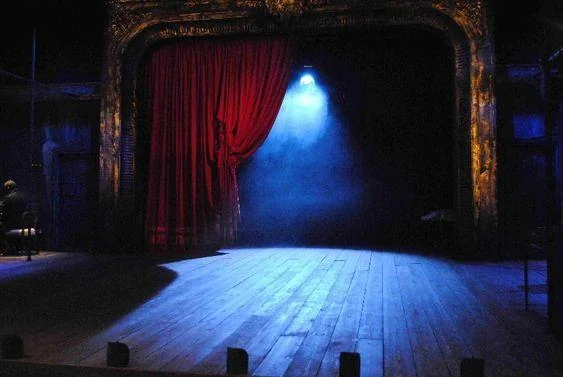
And soon enough, it was time. All I had to do was walk to centre stage and sit. In the darkened theatre, I was barely able to see the outline of the extravagant, wingback chair the stagehands had placed for me. Nice and secure. Simply get there, and sit, I thought to myself. And I…I don’t know…I just did it. I walked onstage, and with each deep breath I took, reason began to win over self-doubt. “You have no choice. You have to do this. For Oscar. For them. Just give them what they want. What they expect.”
And I think that was what did it. That word, “expect.” I remembered that they believed in me. That they were on my side, there to celebrate with me, to pay homage to a magnificent man we all mutually love and admire. How could I have even considered abandoning my part in giving them this joy?
I took my seat, and as the lights came up, I looked out at my sea of believers and fellow Wildeans, smiled, picked up my manuscript, and soon enough, they were laughing and smiling with me, devouring from the palm of my hand, each exquisite phrase quoted from our beloved Oscar. And I remembered why I do this.